Your car AC starts blowing lukewarm air in the middle of a Sharjah afternoon. A friend says it only needs gas. Sometimes that advice is right, and sometimes it sends you back to the workshop three weeks later.
A gas refill puts refrigerant back into the system so it reaches its factory charge. AC repair fixes the fault that stopped the system from cooling, such as a leak, a failing compressor, a dead fan or a faulty sensor. The refill treats the symptom. The repair treats the cause. A car AC is a sealed loop, so if the gas level has dropped, something is letting it out.
The Numbers Behind Gas and Repairs
Most passenger cars hold well under one kilogram of refrigerant. That small charge does all the cooling work, so even a modest loss shows up as weaker air at the vents.
The type of gas also changes the bill. Older cars use R-134a. Most newer models use R-1234yf, which has a global warming potential of 4 compared with 1,430 for R-134a, according to the US EPA. The newer gas is far cleaner for the climate but costs much more per kilo, so refills on recent cars are pricier.
Across UAE workshops, a basic R-134a top-up usually lands somewhere around AED 120 to 300. Repairs vary far more, from a small O-ring job to a full compressor replacement that runs into the thousands.
Gas Refill vs AC Repair at a Glance
Point | AC gas refill | AC repair |
What it fixes | Low refrigerant level | The fault behind poor cooling |
Typical trigger | Slow loss over years, or after a repair opened the system | Leak, compressor fault, fan failure, sensor or electrical issue |
Time in workshop | Usually under an hour | A few hours to a full day |
Diagnosis needed | Pressure test and leak check first | Full system diagnosis |
Result if wrong choice | Gas escapes again within weeks | Not applicable, cause is removed |
Cost range | Lower, mostly gas and labour | Wider, depends on the part |
When a Refill on Its Own Makes Sense
A refill is the right call in a few clear cases. The first is a car several years old that has lost a little gas through normal seepage, with no leak found under UV dye or an electronic detector.
The second is straight after a repair. Any job that opens the circuit, like replacing a condenser or hose, ends with a vacuum and a fresh charge.
The third is when the system holds pressure during a test. If the pressure stays steady and cooling returns, a top-up is enough for now.
When You Need Repair Instead
Repair is the answer when the gas keeps disappearing. If your last refill lasted only weeks, there is a leak that needs finding and sealing.
Other faults have nothing to do with gas at all. A compressor clutch that will not engage, a radiator fan that stays off, or a blend door stuck on hot will all cause warm air with a full charge. Weak cooling only while stopped often points to fan or condenser trouble, which our post on cooling at idle explains in detail. A clicking compressor that switches on and off rapidly is a separate symptom covered under compressor cycling.
Why Repeat Refills Cost More in the End
Refrigerant carries compressor oil around the system. When gas leaks out, some oil leaves with it. A low charge also means less oil reaches the compressor, so it runs hotter and wears faster.
So every quick refill on a leaking system has two costs. You pay for gas that will escape again, and the compressor loses a little life each time. A compressor replacement usually costs far more than finding and fixing the original leak.
How the Refrigerant Type Affects Your Bill
Detail | R-134a | R-1234yf |
Common in | Older and many budget models | Most newer European, American and Japanese cars |
Global warming potential | 1,430 | 4 |
Safety class | Non-flammable | Mildly flammable, needs dedicated equipment |
Gas cost | Lower | Much higher per kilo |
Can they be mixed | No | No |
Your car’s gas type is printed on a sticker under the bonnet. Newer German models, including many cars we see from our Mercedes and BMW customers, run on R-1234yf. The two gases use different service ports and machines, so a workshop must have the right equipment for your car.
How a Proper Check Decides Between the Two
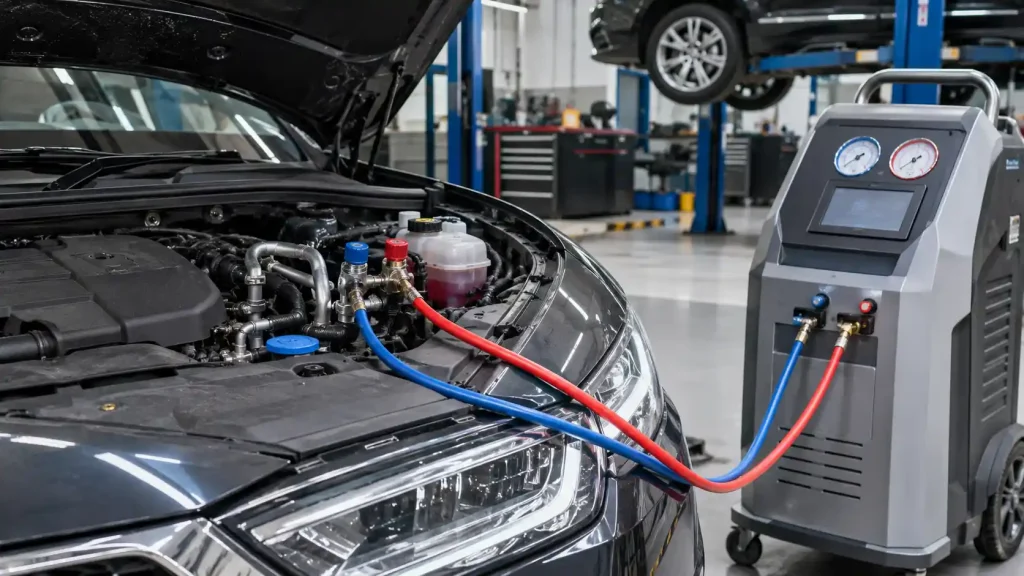
A good workshop never guesses. At Car AC Repair Sharjah, technicians first read system pressures and then trace leaks with UV dye and an electronic detector. The system is pressure-tested before any recharge, so you only pay for gas that will stay put.
If the test points to a fault, you get a written fixed price before any repair starts. There is no hidden callout or assessment fee. Both R-134a and R-1234yf systems are handled in the Industrial Area 10 workshop.
Conclusion
A gas refill and an AC repair solve different problems. The refill restores the charge, while the repair removes whatever made the charge drop or the cooling fail. Topping up without testing often wastes money and shortens compressor life. A pressure test and leak check settle the question in minutes. For an honest diagnosis and a fixed price before any work, book your car AC repair with Car AC Repair Sharjah today.
Frequently Asked Questions
Can I just refill my car AC gas every summer?
You can, but a yearly need for gas means the system is leaking. Each refill lets oil escape and strains the compressor, so fixing the leak once usually works out cheaper than paying for gas every year.
How do I know if my car needs gas or a repair?
You cannot tell reliably from the vents alone. A pressure reading and a leak test show whether the charge is low and why. If the system holds pressure, gas may be enough; if not, a repair comes first.
Is a gas refill part of AC repair?
Yes, most repairs end with a refill. Once a part like a hose or condenser is replaced, the system is vacuumed and recharged to the exact factory amount, so the gas and the fix work together.
Why is gas for newer cars more expensive?
Most newer cars use R-1234yf, which is costlier to make than the older R-134a. It also needs dedicated machines because it is mildly flammable, and that equipment cost is reflected in the price of each refill.
How long should a car AC gas refill last?
On a healthy sealed system, a full charge should last several years with only small natural losses. If cooling fades within weeks or months of a refill, a leak is almost certain and needs tracing before more gas goes in.