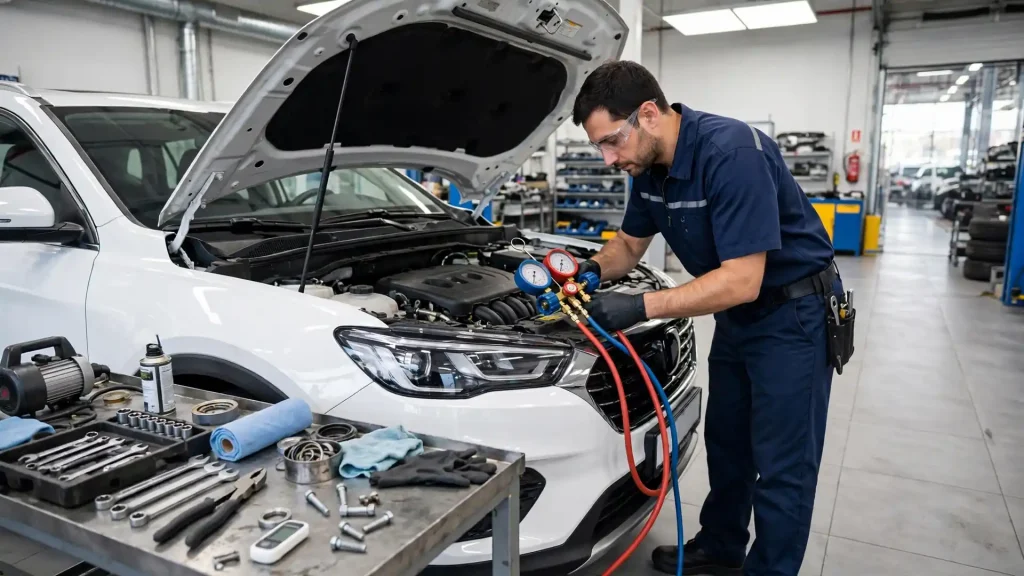
A car AC can work well for years when its main parts are checked and maintained at the right time. Small AC problems may seem harmless at first, but they can become costly if they are ignored for too long.
Regular car service helps prevent expensive AC repairs by finding low refrigerant, blocked condensers, dirty filters, weak belts, leaks, and other issues before they damage major parts.
In Sharjah, high heat, dust, and long hours in traffic can place extra stress on the cooling system. Routine checks help the AC stay efficient and reduce the risk of major component failure.
Why Regular AC Service Matters in Sharjah
Sharjah’s hot climate can make the car AC work hard for long periods. During summer, the system may run almost every time you drive, especially when the car has been parked outside.
Dust and sand can collect around the condenser and other parts, reducing airflow and heat transfer. Regular servicing helps remove this build-up and checks whether the system is working within the correct pressure range.
Finding a small problem during routine service is usually easier and less costly than waiting until the compressor or another major AC component fails.
Main Ways Regular Service Prevents Expensive AC Repairs
Regular maintenance does more than keep the cabin cool. It protects several parts that work together to produce cold air. A small issue in one part can put extra pressure on another part. For example, low refrigerant can make the compressor work harder, while a blocked condenser can cause pressure to rise. The following checks can help prevent these problems from becoming major repairs.
1. Protects the AC Compressor
The AC compressor is one of the most important and expensive parts of the cooling system. It circulates refrigerant and helps move heat out of the cabin. If the refrigerant level becomes too low, the system may not get enough cooling and lubrication.
This can increase compressor strain and cause excess wear over time. During regular service, technicians can check system pressure, look for leaks, and inspect compressor operation.
Finding low refrigerant or another fault early can help protect the compressor and reduce the chance of a complete compressor failure.
2. Helps Prevent Compressor Burnout
A compressor does not usually fail without a reason. Poor lubrication, low refrigerant, electrical faults, excessive pressure, and long-term wear can all contribute to damage. When the compressor has to keep working under poor conditions, its internal parts can become damaged.
Metal particles from a failing compressor can then move through the AC system and affect other components. Routine checks can catch unusual compressor noise, pressure problems, clutch issues, and poor cooling before the damage becomes severe.
Early repair can cost much less than replacing the compressor and cleaning the complete AC circuit.
3. Keeps the Condenser Clean
The condenser is placed near the front of the car, where it can collect dust, sand, leaves, insects, and road dirt. Its job is to release heat from the refrigerant before the refrigerant moves to the next part of the system.
When the condenser fins become blocked, heat cannot escape properly. This can raise refrigerant pressure and put extra stress on the compressor.
Cleaning the condenser during routine service helps maintain airflow and heat transfer. This simple step can protect the cooling system, especially when the car is often driven in dusty areas.
4. Finds Refrigerant Leaks Early
Refrigerant should not disappear from a healthy closed AC system. If the level keeps dropping, there may be a leak in a hose, seal, pipe, condenser, evaporator, or another connection. Small leaks can be difficult to notice because refrigerant escapes as a gas.
The AC may still cool for some time before the problem becomes obvious. Regular pressure checks and leak testing can help find the source early.
Repairing a small leak is generally better than repeatedly adding refrigerant and allowing the system to operate with an incorrect charge.
5. Keeps the Cabin Air Filter Clean
The cabin air filter stops dust, pollen, sand, and other particles from entering the cabin through the ventilation system. Over time, the filter becomes dirty and can restrict airflow. A blocked filter makes the blower work harder and may reduce the amount of air passing across the evaporator.
Poor airflow can affect cooling and may contribute to evaporator icing in some cases. Replacing the filter during scheduled service is a simple maintenance step. It can improve airflow, support better cooling, and help keep the air inside the car cleaner.
6. Helps Prevent Evaporator Problems
The evaporator is responsible for absorbing heat from the air inside the cabin. Dust and dirt can collect around it when filtration or maintenance is poor. A dirty evaporator can reduce airflow and make it harder for the AC to cool the cabin properly.
Moisture can also collect in the AC system, creating conditions that may lead to unpleasant smells. Regular inspection and cleaning can help prevent heavy dirt build-up.
Keeping the evaporator and surrounding parts clean allows the cooling system to move air more effectively and reduces the chance of larger AC problems.
7. Reduces Engine and Belt Strain
The AC compressor is connected to the engine through a drive belt in many cars. When the compressor is struggling because of a mechanical or pressure problem, it can place extra load on the engine.
A damaged compressor bearing or clutch can also affect the belt and pulley system. This may lead to unusual noises, poor AC performance, or belt wear.
Regular service allows technicians to inspect the compressor, belt, pulley, and related parts. Fixing a small issue early can help prevent damage that affects both the AC system and engine accessories.
8. Helps Maintain Correct Refrigerant Pressure
Refrigerant pressure plays an important role in AC performance. Both very low and very high pressure can cause problems. Low pressure may point to a refrigerant leak, while high pressure can be linked to overcharging, poor condenser airflow, or cooling fan problems.
A pressure check during AC service gives technicians useful information about system health. The correct pressure depends on the vehicle and outside conditions, so refrigerant should not be added based only on guesswork.
Keeping the charge within the correct range helps the compressor and other AC parts work properly.
9. Helps Detect Cooling Fan Problems
The condenser needs airflow to remove heat from the refrigerant. When the car is moving, air passes through the front of the condenser, but the cooling fan becomes especially important when the car is stopped or moving slowly.
If the fan is weak or not working, refrigerant pressure can rise. This can reduce cooling and place extra stress on the AC system. During regular service, the cooling fan, relay, fuse, wiring, and motor can be checked. Finding a fan problem early can prevent high-pressure issues and poor AC performance during traffic.
10. Reduces the Risk of Bad AC Smells
A car AC system deals with moisture as it cools the air. If moisture remains around the evaporator or the drain becomes blocked, it can create a damp environment. Dust and dirt can make the problem worse and may lead to unpleasant smells when the AC starts.
A dirty cabin filter can add to the issue. Routine service can include filter replacement, evaporator cleaning, drain inspection, and AC sanitization when needed.
Keeping these areas clean helps improve cabin air quality and reduces the chance of odor problems becoming a regular complaint.
What Does Regular AC Service Include?
A proper AC service should involve more than simply adding refrigerant. The technician should look at the complete cooling system and check how the parts work together. The exact service can vary by vehicle and its condition, but common checks include:
- AC cooling performance
- Refrigerant pressure
- Refrigerant leaks
- Compressor operation
- Compressor clutch
- Condenser condition
- Cooling fan operation
- Cabin air filter
- Evaporator condition
- AC pipes and hoses
- Electrical connections
- Fuses and relays
- Drain system
- Unusual noises or smells
These checks can help find early signs of wear before they become major faults.
How Often Should You Service Your Car AC in Sharjah?
The right service interval depends on the vehicle, driving conditions, age, and AC condition. However, regular checks are useful in Sharjah because hot weather and dust can place extra demand on the system.
A basic inspection every six months can help catch changes in cooling performance and filter condition. A more detailed check once a year can include refrigerant pressure, leak testing, condenser cleaning, and compressor inspection.
A deeper AC service may be useful every two years, especially for older cars or vehicles that operate in heavy traffic every day.
Recommended Car AC Maintenance Schedule
Following a simple schedule can make AC maintenance easier and help prevent unexpected repair costs. The following plan provides a useful starting point for many car owners.
Service Interval | Recommended Checks |
Every 6 months | Check cooling performance and inspect or replace the cabin filter |
Every 12 months | Check refrigerant pressure, inspect for leaks, clean the condenser, and check compressor operation |
Every 2 years | Perform deeper AC service, vacuum testing, refrigerant service, and system sanitization when required |
Any time cooling changes | Inspect the system instead of waiting for the AC to stop working |
The exact schedule should always be adjusted based on the vehicle manufacturer’s maintenance advice and the condition of the AC system.
What Happens If You Skip AC Maintenance?
Skipping routine service does not always cause an immediate problem. The AC may continue to produce cold air even when a small fault is already developing. For example, a slow refrigerant leak may reduce system performance over several months.
Dust may slowly block condenser fins, while a cabin filter may become heavily clogged. Eventually, the compressor may have to work harder, or another part may fail.
At that stage, the repair can become much more expensive. Regular checks help reduce this risk by dealing with small problems before they affect other components.
Signs Your AC Needs a Service
Your car may give several warning signs when the AC system needs attention. You should not wait for complete failure if you notice changes in performance. Common signs include:
- Air is not as cold as before
- Cooling takes longer than usual
- AC works better while driving than when stopped
- Compressor switches on and off too often
- Strange clicking or grinding sounds appear
- Airflow from the vents becomes weak
- Bad smells come from the vents
- Ice appears on AC pipes
- The cabin takes too long to cool
- The AC stops cooling during heavy traffic
These signs do not always mean a major repair is needed. Early inspection can help identify the actual cause.
Why Early AC Repairs Usually Cost Less
A small AC fault can affect other parts if it is ignored. A minor refrigerant leak, for example, may seem like a simple problem. However, continued operation with low refrigerant can place extra stress on the compressor.
If the compressor later fails, the repair may involve more parts, labor, refrigerant, and system cleaning. The same idea applies to blocked condensers, faulty cooling fans, dirty filters, and electrical problems.
Fixing the first sign of trouble can prevent a chain of failures. This is why routine service is a useful way to control long-term car maintenance costs.
Should You Only Service the AC When It Stops Cooling?
No. Waiting until the AC stops working completely can increase the chance of a costly repair. Some problems develop slowly while the system continues to produce cool air. A small refrigerant leak, weak compressor clutch, blocked condenser, or failing cooling fan may not cause immediate failure.
By the time the AC stops cooling, another part may already be damaged. Routine inspection gives you a chance to find these problems earlier. Preventive service is usually a better approach than treating the AC only after a complete breakdown.
Choose Regular AC Service to Protect Your Car
Regular car service can help protect the AC compressor, condenser, evaporator, filters, belts, cooling fans, and electrical parts. In Sharjah, this matters even more because high temperatures, dust, and heavy traffic can place extra pressure on the system.
Checking refrigerant pressure, finding leaks, cleaning the condenser, replacing filters, and inspecting the compressor can prevent small faults from becoming expensive repairs. Good AC maintenance is not only about getting colder air.
It helps keep the complete cooling system working properly and can reduce the chance of sudden repair costs.
Conclusion
Regular car service is one of the simplest ways to reduce the risk of expensive AC repairs. Checking refrigerant levels can help protect the compressor, while condenser cleaning supports proper heat release.
Replacing the cabin filter improves airflow, and early leak testing can stop a small refrigerant problem from causing wider damage. In Sharjah’s hot and dusty conditions, these checks become especially important.
If your AC is showing weak cooling, strange sounds, poor airflow, or repeated cycling, getting it checked early can save both time and money.
For reliable AC inspection, maintenance, and repair, contact Car AC Repair Sharjah. Professional service can help find small faults early, keep your cooling system working efficiently, and reduce the risk of major AC repairs.